What is an AI factory?
An AI factory is a way of working in which software agents carry out the work between a human-written request and a human-verified result, inside a shared, governed setup rather than on one person's laptop.
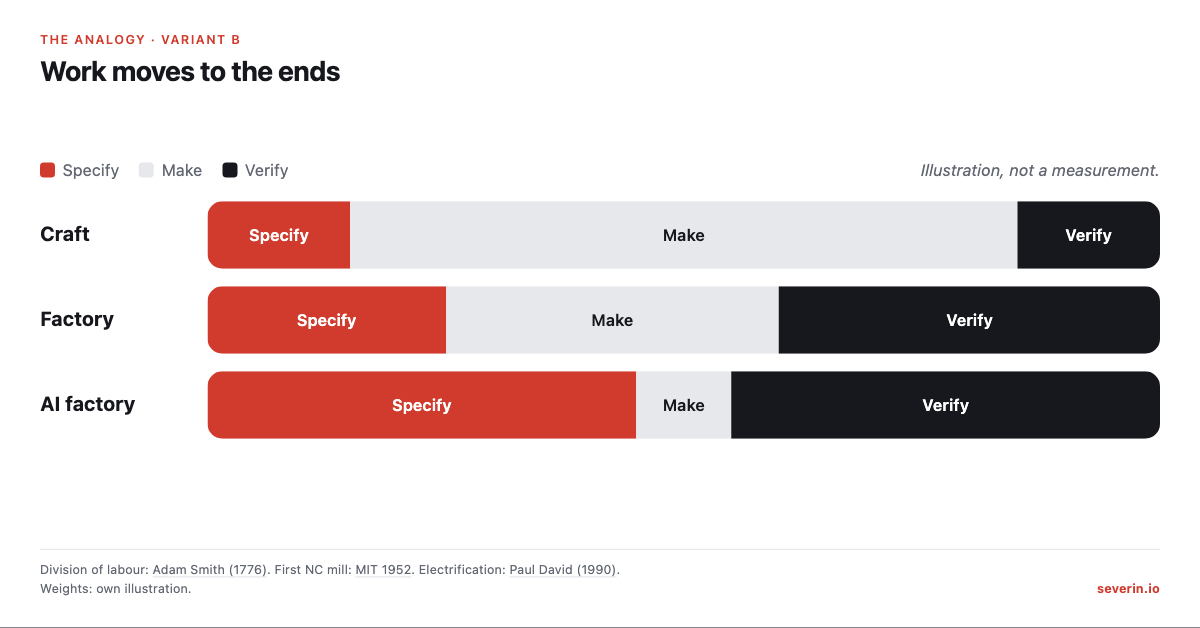
- People own the two ends: what goes in (requirements) and what comes out (acceptance). Agents do the middle.
- Most teams are not there yet. They use AI as an assistant, each with a private setup.
- The step up is less about better models and more about structure: tickets, approval gates and evidence.
How is an AI factory different from using a chatbot?
A chatbot answers one person, one question at a time. You copy something in, copy something out and check it yourself. An AI factory starts from a written request, plans, builds and tests on its own, and comes back with proof. It is shared by a team, it follows the same rules for everyone, and it stops at defined points where a person decides.
What are the levels between autocomplete and a dark factory?
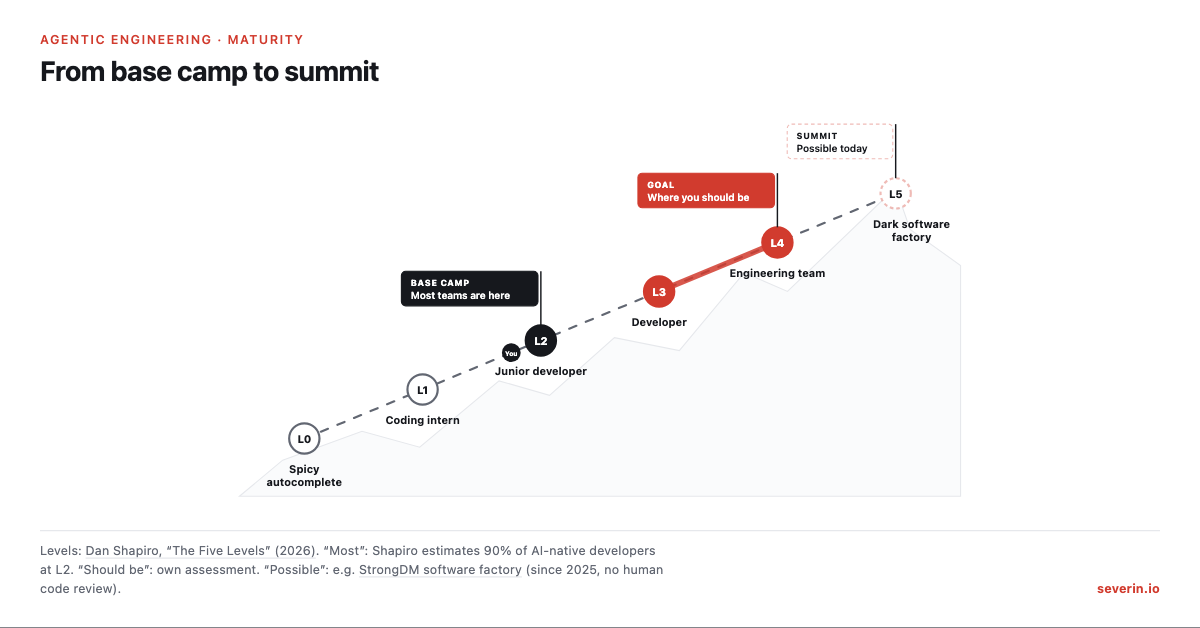
Dan Shapiro described six levels of AI-assisted software development in January 2026, modelled on the levels of driving automation:
| Level | Name | Who does what |
|---|---|---|
| L0 | Spicy autocomplete | AI is a better search. The developer writes the code. |
| L1 | Coding intern | AI writes boilerplate. The developer reviews every line right away. |
| L2 | Junior developer | Pair programming. Developer and AI trade control, the human reads along. |
| L3 | Developer | AI writes most of the code. The developer reviews everything and is the bottleneck. |
| L4 | Engineering team | AI runs unattended for long periods. The human checks results, not every step. |
| L5 | Dark software factory | The engineer manages goals and the system. The AI implements, tests, fixes and ships. |
Shapiro estimates that 90% of AI-native developers work at L2 and that almost everyone tops out at L3. That is his estimate from working with dozens of companies, not a survey. It matches what I see with clients. In Switzerland, 69% of organisations in one survey explore agentic AI, but 90% keep agent autonomy at zero or human in the loop.
L5 exists. Since July 2025 StrongDM has run a software factory with two rules: code must not be written by humans and code must not be reviewed by humans.
Where do most companies stand today?
Nearly nine in ten companies use AI regularly, but only 44% say it is scaling across the enterprise (McKinsey, 2026). In Switzerland, 14% of companies scale AI systematically across several areas (EY, 2026). The tools have arrived; the way of working has not.
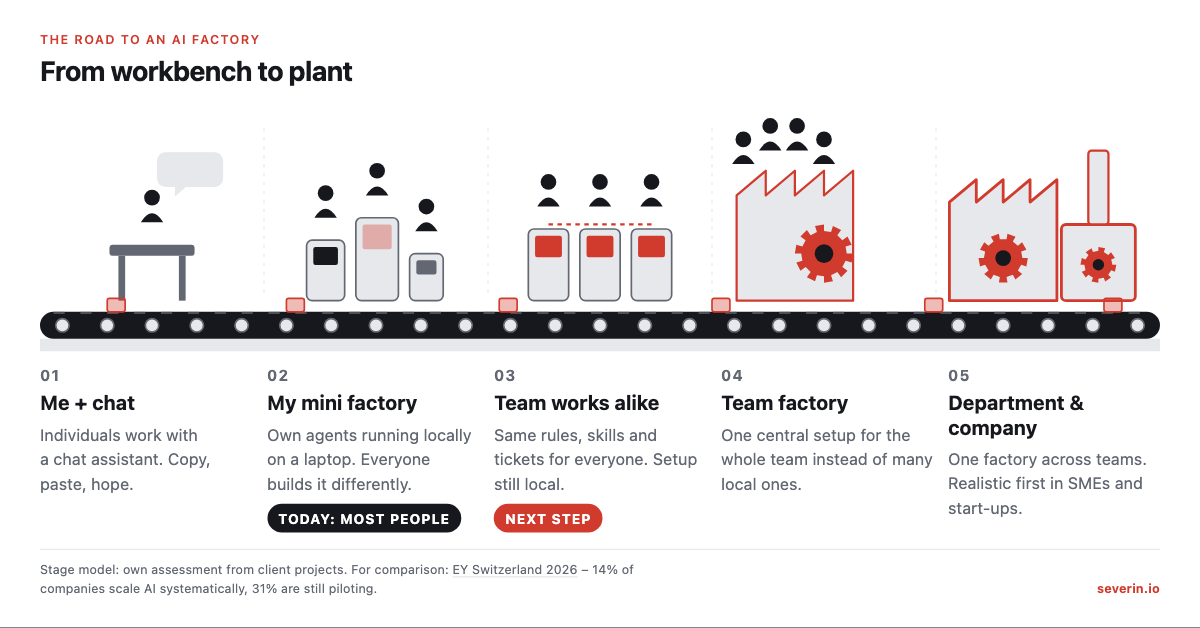
In my experience the path has five stages: one person with a chat assistant; a private mini factory on one laptop; a team that works the same way with shared rules, skills and tickets; one central factory for the whole team; and finally a factory across a department or company. The last stage is unlikely company-wide in large enterprises, but realistic for small companies and start-ups.
What does it take to get from L3 to L4?
At L3 the human reviews everything and becomes the bottleneck. Moving on requires trusting the system's checks without trusting its claims. Three things make that possible:
- Tickets instead of chat. Requirements, acceptance criteria and the plan live in a ticket, not in a conversation.
- Approval gates. A person approves the requirements, approves the plan and gives the final verdict. Agents ask only when a decision is critical.
- Evidence. Agents collect ground truth from the environment at each step, as Anthropic recommends: test output, row counts, diffs and screenshots. A person spot-checks the real system before anything goes live.
I describe this way of working in detail on the orch concept page.
Why "factory"? The industrialisation analogy
Before factories, a weaver knew every step of making cloth. In a factory, people understood what went in and what came out; the machine did the middle. In Uster in 1832, home weavers burned down a mechanical weaving mill after their petition to ban weaving machines was ignored, the most significant case of machine-breaking in Switzerland.
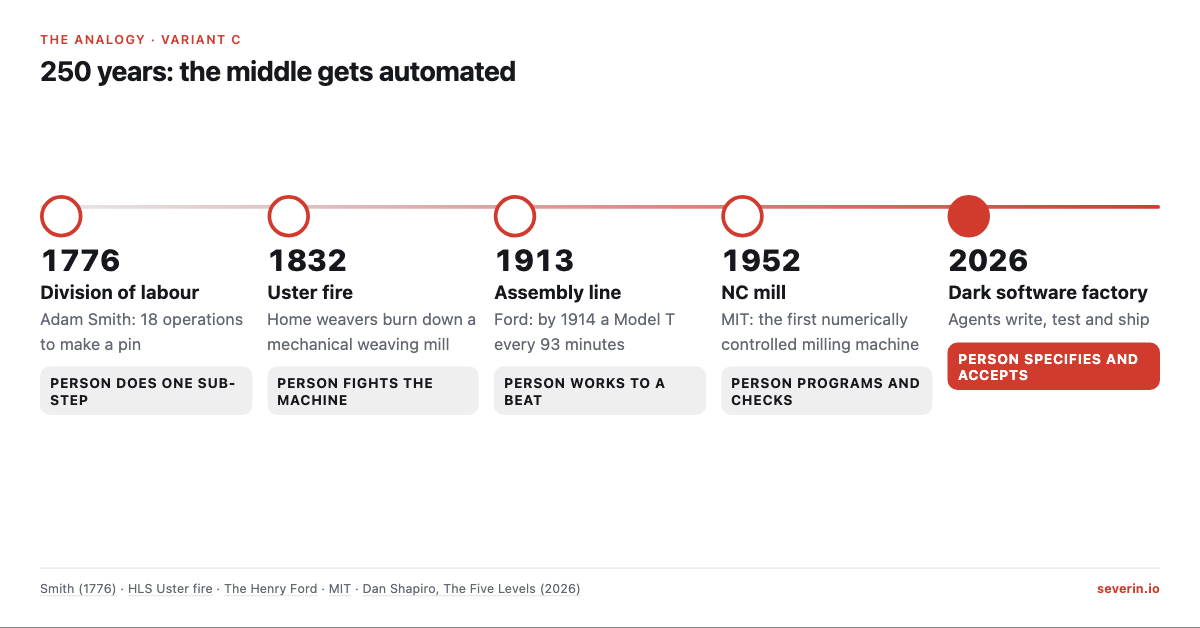
Knowledge work is going through the same shift. Engineers used to write every line. In an AI factory they specify what should be built and verify what comes out. A few experts will keep understanding the middle in detail; everyone else needs to become very good at specifying and verifying.
The second lesson matters more. When factories electrified around 1900, many simply swapped the steam engine for an electric motor, and productivity barely moved. It rose only in the 1920s, about four decades after the first power station, once each machine had its own motor and factories were redesigned around it (Paul David, 1990). Bolting a chatbot onto an old process is the electric motor on the old drive shaft. The gain comes from redesigning the workflow.
What can go wrong?
Gartner expects over 40% of agentic AI projects to be cancelled by the end of 2027 because of cost, unclear value or inadequate risk controls. Agent capability grows fast (the length of tasks agents can complete has doubled roughly every seven months, according to METR), but capability without control produces confident mistakes. The gates and the evidence are what make the speed usable.
Sources
- Dan Shapiro's Blog (danshapiro.com): The Five Levels: from Spicy Autocomplete to the Dark Factory (2026-01-23)
- Dan Shapiro's Blog: The Five Levels: from Spicy Autocomplete to the Dark Factory (2026-01-23)
- StrongDM: StrongDM AI Software Factory (2025-07-14)
- EY Schweiz: EY AI Survey 2026 (press release) (2026-05-27)
- McKinsey & Company (QuantumBlack): The state of AI in 2026: On the road to ROI (2026-08)
- Colombus Consulting, Oracle, HEG Genève: Data & AI Observatory in Switzerland – 2026 (2026)
- METR: Measuring AI Ability to Complete Long Tasks (2025-03-19)
- American Economic Review, Papers and Proceedings 80(2): The Dynamo and the Computer: An Historical Perspective on the Modern Productivity Paradox (Paul A. David) (1990-05)
- American Economic Review, Papers and Proceedings 80(2): The Dynamo and the Computer (Paul A. David) (1990-05)
- Historisches Lexikon der Schweiz (HLS): Usterbrand (Markus Bürgi, Bruno Schmid) (2013-02)
- Gartner: Gartner Predicts Over 40% of Agentic AI Projects Will Be Canceled by End of 2027 (2025-06-25)
- Anthropic: Building effective agents (2024-12-19)
How to cite this page
Lindenmann, S. (2026). What is an AI factory?. severin.io. https://severin.io/en/posts/ai-factory/ (updated 2026-10-07)